Vía Xurra Cycle–Pedestrian Footbridge
over the Carraixet Ravine (Valencia)
CONSTRUCTION
PROJECT
BAckground
The Vía Xurra has become a cycle–pedestrian route that makes use of the historic alignment of the former railway line connecting Aragón with València, passing through several towns in the l’Horta Nord region, such as Almàssera, Alboraia, Meliana and Rafelbunyol. This route is used for leisure purposes and, thanks to its direct connection with València, also enables short‑distance journeys on foot or by bicycle.
The route begins at Zaragoza Square in València and runs northwards between the Polytechnic University of València and the Benimaclet district. Upon reaching the Carraixet ravine, the continuity of the route is interrupted due to the disappearance of the former railway bridge.
To cross the riverbed, users must divert towards the CV‑311 road, downstream from the Vía Xurra alignment, where a cycle lane runs along the river embankments and across the existing CV‑311 structure.
The issue at this crossing was that the available space was limited and shared by pedestrians, cyclists and motor vehicles. It should be noted that this road is one of the provincial roads managed by the Valencia Provincial Council with the highest average daily traffic volumes in the province.
On the other hand, along the service road on the left bank of the ravine, from the CV‑311 diversion area to the point where the route reconnects with the Vía Xurra, the cycle–pedestrian path runs along the outer side of the roadway. This road, known as Camino del Barranco, carries a significant volume of traffic, as it is one of the main access routes to Almàssera from the city of València via the CV‑311 road.
However, the path on the right bank of the ravine is not classified as a road, but rather as a pedestrian path associated with the river embankment, as vehicle access is only authorised for vehicles belonging to the Júcar River Basin Authority and for owners of nearby plots.
The land adjacent to the Carraixet ravine within the scope of the project, outside the public hydraulic domain, is mainly classified as agricultural, with the exception of one of the plots within the project area, which is classified as residential.
With regard to hydraulic conditions, the Carraixet Ravine corresponds to a Mediterranean torrential watercourse, which typically carries a very limited flow and is densely vegetated, but which can convey excessive flows during rainfall events due to its large associated catchment area.
Project Description
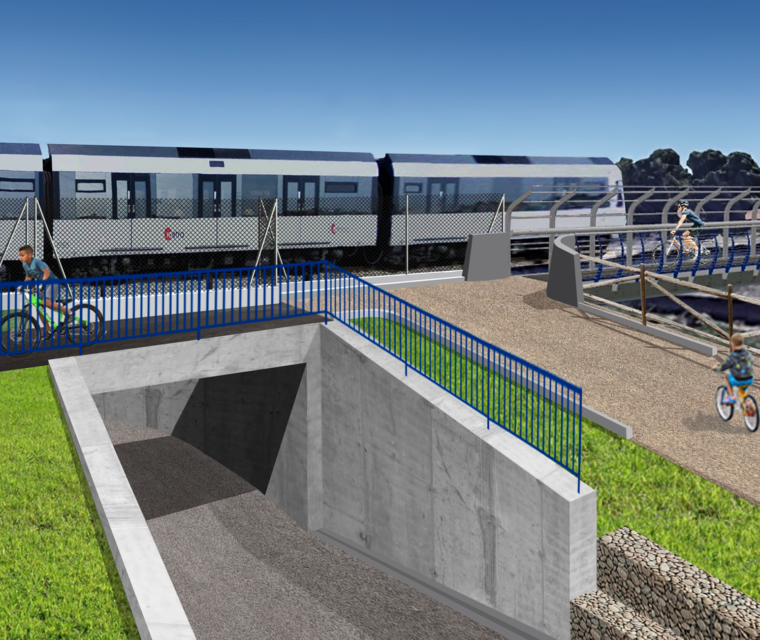
The proposed solution was justified by the need to improve conditions for vehicular, pedestrian and cyclist traffic by enhancing connectivity between both banks of the Carraixet ravine through the creation of accessible cycle–pedestrian routes. This approach promotes a sustainable and safe mobility model aimed at encouraging non‑motorised modes of transport. In addition, the project sought to achieve the integration of both the structure and the typical cross‑sections, as well as the construction materials used in the routes, into the surrounding agricultural environment, adapting them to existing paths and to the landscape setting of the Huerta de València.
These actions consisted, in broad terms, of constructing a cycle–pedestrian footbridge to connect both banks of the Carraixet ravine and developing cycle–pedestrian routes to improve permeability for users and non‑motorised vehicles within the project area.
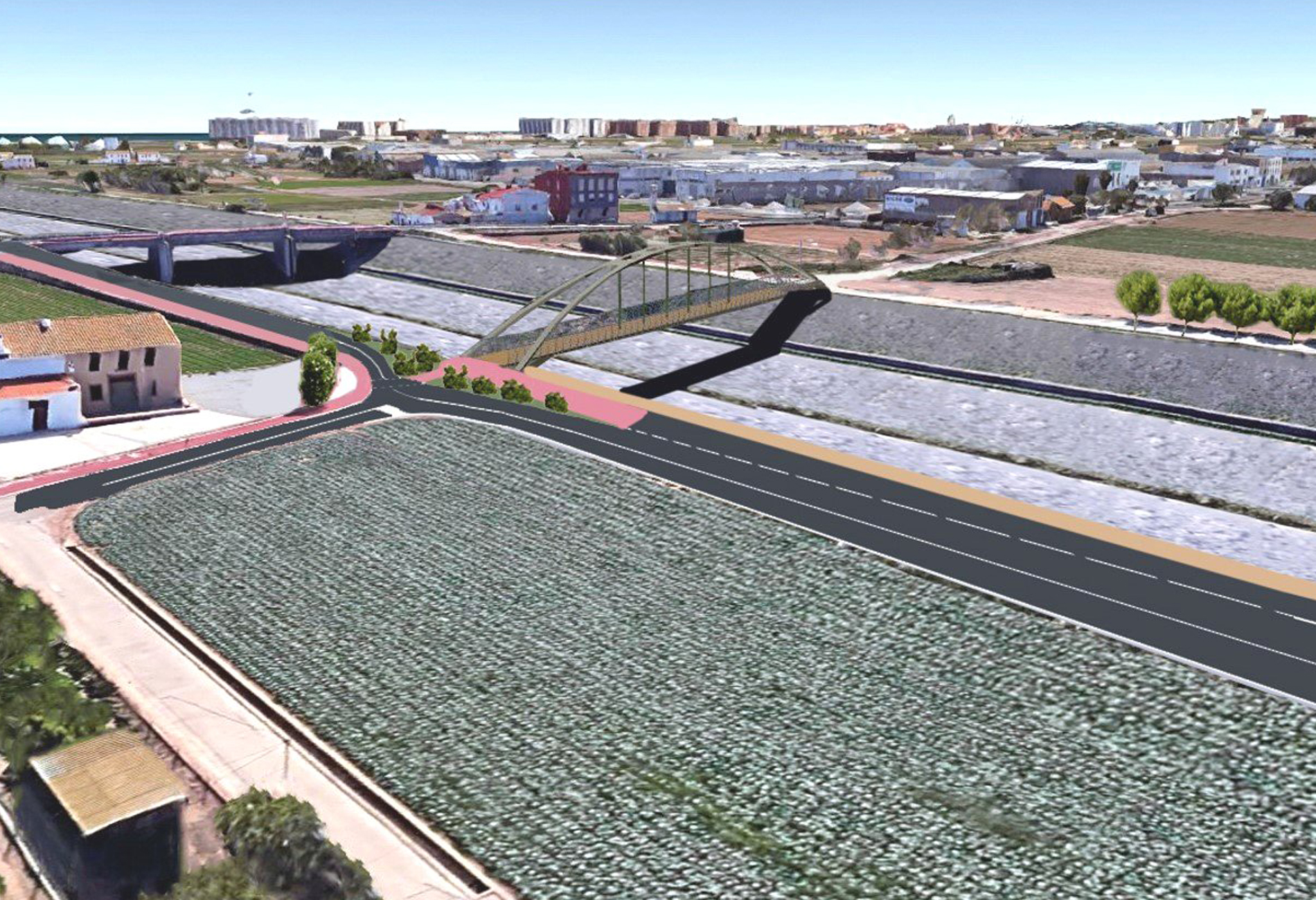
With regard to the cycle–pedestrian footbridge, a steel structure was selected, featuring a single span with a total length of 70.00 m and a clear width of 5.00 m. Structurally, it is a tied arch “bow‑string” bridge, whose plan geometry results from the intersection of a parabolic cylinder and two vertical‑axis cylinders with a circular directrix.
At the access points to the footbridge, the resulting geometry widens to its maximum, creating openings that allow access to the deck beneath the arch, acting as entrance portals. In addition, the footbridge is equipped with 1.40 m‑high railings on both sides, designed with a curved shape to prevent climbing.
The deck consists of a 70 mm deep galvanised steel profiled sheet with a thickness of e = 1 mm, combined with a 0.09 m thick concrete compression layer, functioning as a composite slab made up of a collaborating steel deck and concrete. The landing areas of the footbridge were raised using access ramps with a 3.5% gradient.
With regard to the cycle–pedestrian routes, on the left bank the existing cycle lane was retained and regularised with a slurry seal layer. In the landing area on this bank, a change in the alignment of the cycle–pedestrian route was introduced, as it runs upstream from the footbridge alongside the ravine embankment. This section consists of a single carriageway made up of two 3.00 m‑wide traffic lanes, one in each direction, and a 2.50 m‑wide cycle–pedestrian path, separated by a 1.00 m‑wide buffer strip where separating kerbs were installed. In addition, a 1.00 m‑high wooden safety barrier was installed between the Carraixet ravine and the cycle–pedestrian path.
With regard to the cycle–pedestrian routes on the right bank, they have a variable width ranging between 4.00 and 5.00 m, and their regularisation and landscape integration were achieved through the use of stabilised granular material.